





By Cenango | AI & Digital Transformation
You’ve probably seen both terms a lot lately — chatbot and conversational AI. They sound similar. Many businesses use them like they’re the same thing. But here’s the truth: they’re not the same. Not even close.
Pick the wrong one? You’ll get frustrated customers and wasted money. Pick the right one? That’s where the magic happens.
Let’s break it down — no jargon, no fluff — so you can walk away knowing exactly which solution makes sense for your business.
First, Let's Clear Up the Confusion
Think of it this way: all conversational AI tools can be called chatbots, but not all chatbots are conversational AI. It’s like saying all SUVs are cars, but not all cars are SUVs. Same category, very different capabilities.
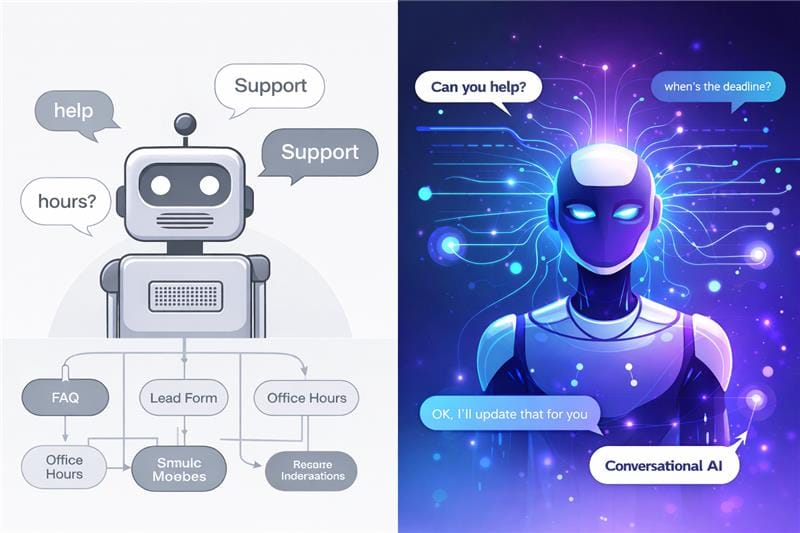
A traditional chatbot is rule-based. It follows a script. You ask a question. It looks for a matching keyword. Then it gives you a pre-written answer. Simple, yes. Predictable, sure. But when you need something more? Pretty limiting.
Conversational AI works differently. It uses machine learning and natural language processing (NLP). It doesn’t just match keywords. It actually understands what you’re saying. Your intent. Your context. Even the tone of your message. It responds the right way. Plus, it’s built on models that keep getting better. Teams refine it through data analysis and updates. Over time, it handles more types of talks with better accuracy.
In short: chatbots follow a map. Conversational AI reads the road.
The Classic Chatbot: Where It Shines (and Where It Doesn't)
Chatbots have been around since 1966. Yes, really. The very first one was ELIZA. It was built at MIT by computer scientist Joseph Weizenbaum. They’re fast to build. Easy to set up. Great for simple, repetitive tasks. If your business needs to answer the same ten questions over and over again, a chatbot can do that job well and cheaply.
Where chatbots work well:
- Answering FAQs on a website
- Collecting basic contact information
- Routing customers to the right department
- Confirming appointment times or order statuses
But the moment a customer goes off-script? The chatbot breaks down. Maybe they ask something unexpected. String two questions together. Make a typo. The bot might give a totally wrong answer. Or worse, just loop the same message over and over. That’s not a great look for any business.
Here’s the honest truth: customers have gotten smarter. They know when they’re talking to a bot. And they’ve grown tired of the ones that feel robotic and useless. If your bot can’t hold a real conversation, it can hurt your brand more than help it.
Conversational AI: The Next Level of Customer Engagement
Conversational AI changes the game. Picture this: A customer reaches out at 11 PM on a Sunday. They’re frustrated. Their order is delayed. A traditional chatbot might say, “I’m sorry, I didn’t understand that. Please choose from the following options.”
A conversational AI agent? It gets their frustration. It pulls up their order details. It gives them an update and offers a fix. All of this happens without a single human agent.
That’s not a fantasy. That’s what modern conversational AI is already doing across industries right now.
What makes conversational AI stand out:
It understands natural language. People don’t talk like dropdown menus. They use slang. They use shortcuts. They use incomplete sentences. Conversational AI handles all of it with ease.
It keeps context across the whole chat. A customer says, “Change my appointment to next Thursday — wait, make it Friday.” Conversational AI tracks that shift in real time. A rule-based chatbot would get confused after the first request.
It improves through data-driven updates. Unlike static rule-based bots, conversational AI systems get refined over time. Teams use data analysis and feedback loops. They do model updates. The system gets more accurate and more capable as more work goes into it.
It handles complex, back-and-forth talks. Sales. Support. Onboarding. Lead scoring. Conversational AI can manage detailed interactions that used to need a human agent.
Head-to-Head: How They Stack Up
| Feature | Traditional Chatbot | Conversational AI |
|---|---|---|
| Setup complexity | Low | Medium to High |
| Cost | Lower upfront | Higher investment, strong ROI |
| Language understanding | Keyword matching | Natural language processing |
| Context retention | Limited | Full conversation context |
| Personalization | Minimal | Deep and dynamic |
| Learning capability | Static | Continuous improvement |
| Best for | Simple, repetitive tasks | Complex, high-value interactions |
So, Which One Does Your Business Actually Need?
Here’s how to think about it.
Choose a traditional chatbot if:
- You’re a small business with a tight budget and simple customer questions
- You need a quick fix for one specific use case (like getting leads on a landing page)
- Your customer talks don’t need back-and-forth
- You want something live in days, not weeks
Choose conversational AI if:
- Your customers want 24/7 support with real answers, not scripted menus
- You’re in a high-stakes field like healthcare, real estate, finance, or legal services where details matter
- You want to automate complex work — booking, scoring leads, follow-ups — end to end
- You’re thinking long term and want a system that grows with your business
- You’re losing leads or customers because your current support can’t keep up
The reality is simple. For most growth-focused businesses today, conversational AI isn’t just the better option. It’s becoming the expected standard.
Customers don’t compare you only to your rivals. They compare you to every brand they’ve ever used. Amazon. Netflix. Their bank’s app. The bar is high. And it keeps rising.
Real-World Impact You Can Feel
At Cenango, we’ve seen what happens when businesses make the shift. From basic chatbots to smart conversational AI agents. Real estate companies capture and nurture leads 24/7. No added staff needed. Healthcare providers cut no-show rates with proactive, personal appointment reminders. Financial services firms score prospects before they ever talk to a human advisor.
The results aren’t just about operations. They’re transformational. Response times drop. Customer satisfaction goes up. Teams get to focus on the high-value work that truly needs a human touch.
The Bottom Line
Both chatbots and conversational AI have their place. But if you want to build real relationships with your customers, conversational AI is the way to go. If you want to scale smartly and stay competitive in a world where customer expectations keep rising, this is the direction to move in.
The question isn’t really chatbot vs. conversational AI. It’s where do you want your business to be in three years?
If the answer includes smarter automation, better customer experiences, and a competitive edge, you already know what to do next.
Ready to explore what conversational AI could look like for your business? Get in touch with the Cenango team — we’d love to show you what’s possible.
Tags: Conversational AI, Chatbot, AI Automation, Customer Experience, Business Technology, Digital Transformation
