



}

Conversational AI vs Chatbot: Understanding the Key Differences

Business professionals using laptop and phone for AI customer support interaction.

By Cenango | AI & Digital Transformation

You’ve chatted with a bot online before. Maybe you tracked a package. Maybe you asked about store hours. Or maybe you got three “I’m sorry, I didn’t understand that” replies in a row — and gave up in frustration.

Sound familiar? You’re not alone.

Here’s something most people don’t realize. Not all bots are the same. There’s a big gap between a basic chatbot and what we call Conversational AI. That gap matters — a lot — for your business, your customers, and your bottom line.

Let’s break it down in plain, simple terms.

What Is a Chatbot?

A chatbot is a program built to reply to messages. That’s the short version.

It works by following rules. The user says X. The bot says Y. Think of it like a very detailed script. The bot doesn’t think. It doesn’t learn. It just matches words to set answers.

This is called rule-based logic. It works well for simple tasks. Ask about store hours? Easy. Check an order number? No problem. But go even slightly off-script? The bot gets lost — fast.

Basic chatbots are still useful in the right setting. They’re cheap to build. They run all day and night. They handle high volumes with no effort. For repeat, simple tasks, they get the job done.

Here’s where chatbots shine:

  • Answering common questions (FAQs)
  • Routing users to the right team
  • Checking basic order or delivery status
  • Booking simple, pre-set time slots


But the moment a chat gets real — messy, personal, and complex — a basic chatbot hits a wall. It can’t adapt. It can’t think. And it can’t help.

That’s where things get interesting.
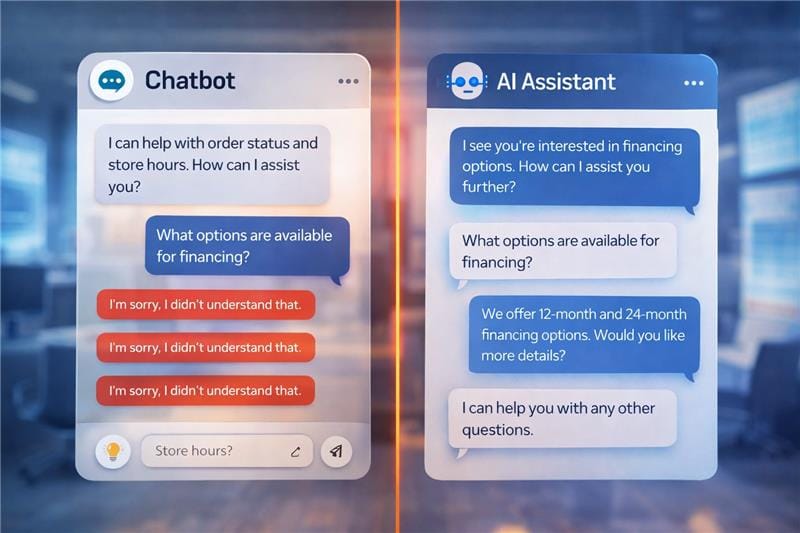
Visual comparison of chatbot and Conversational AI responses.

What Is Conversational AI?

Conversational AI is a whole new level.

Instead of a script, it uses Natural Language Processing (NLP) and Machine Learning (ML) to understand what people mean. It reads intent, not just words. It tracks the full chat. And it gets better over time.

Here’s a simple way to think about it. A chatbot is like a vending machine. Press a button. Get a fixed result. Conversational AI is like a skilled barista. You say, “Something warm, not too strong, a little sweet” — and they get it right every time.

That’s the power of real understanding.

Here’s what makes Conversational AI stand out:

  • Natural Language Understanding (NLU): It grasps meaning, not just keywords
  • Context memory: It tracks the whole chat, not just the last message
  • Sentiment awareness: It picks up on frustration or excitement — and adjusts its tone
  • Ongoing learning: It gets smarter with each new chat
  • Multi-channel support: It works across chat, voice, text, email, and more

It doesn’t just respond. It connects.

Key Differences at a Glance

FeatureTraditional ChatbotConversational AI
IntelligenceRule-based, scriptedAI-powered, adaptive
Language UnderstandingKeyword matchingIntent and context
Learning AbilityStaticLearns and improves
Conversation FlowLinear, rigidDynamic and natural
Handles ComplexityLimitedYes
System IntegrationBasicDeep system links
Best ForSimple, repeat tasksComplex, multi-turn chats

Why This Difference Matters for Your Business

Here’s where it gets real.

Customer needs have changed. People want fast, helpful, and personal replies — at any hour. A bot that says “I don’t understand” three times in a row doesn’t just annoy people. It sends them straight to your rivals.

Conversational AI builds a better experience. It can handle a billing question while offering a relevant upgrade. It can do this at midnight with no human help. And it can do it for hundreds of people at once.

According to Forbes Advisor, 64% of business owners believe that AI will improve their customer relationships. That’s not a small shift. That’s the whole market moving.

For fields like real estate, insurance, healthcare, and finance, this shift is huge. These talks are personal. They’re complex. Trust is key. A scripted bot can’t build that trust. But Conversational AI can.

Here’s a clear example. A homebuyer reaches out to a real estate firm at 11 PM. They want to know about loan options, local schools, and showing times — all at once. A basic chatbot can’t help. It would fail fast.

But Conversational AI can handle all of it. It acts like a skilled agent. It’s on call all day, every day. It never gets tired. It never misses a lead. And it gives each user a personal, on-point reply.

That’s the kind of edge that grows a business.

The Shift: From Scripts to Smart Agents

The tech has moved fast in recent years.

The latest Conversational AI tools use Large Language Models (LLMs). These models can hold deep, detailed talks. They don’t give canned answers. They think in real time. They connect to your CRM, your calendar, and your data — all at once.

These are not just smarter chatbots. They are smart agents.

Here’s what they can do for your business:

  • Qualify leads by asking the right questions and reading the answers
  • Book meetings using live calendar access — no human needed
  • Answer tough questions without a support agent in the loop
  • Hand off to a live person when needed — and pass all context along

This is what platforms like Cenango’s REA solution are built to do. Not just reply. But convert chats into real results.

The global chatbot market reached $7.76 billion in 2024 and is projected to hit $27.29 billion by 2030, growing at 23.3% annually according to Grand View Research. That kind of growth tells a clear story. Businesses see the value. They’re moving fast. Are you?

So, Which One Do You Need?

The honest answer? It depends on your goals.

If your needs are basic and set, a well-built chatbot may work fine. It handles the simple stuff. It’s low cost. It runs on its own.

But if you want to delight customers, catch leads at all hours, cut support costs, and grow across all channels — Conversational AI is the clear choice. It’s not just better. It’s a whole new category.

The good news? It’s more within reach than ever. With the right tech partner, you can be up and running in no time — without the huge cost that used to come with it.

Final Thoughts

“Chatbot” and “Conversational AI” get used like they mean the same thing. They don’t.

A chatbot follows rules. Conversational AI understands people.

One reads words. The other reads intent.

One stays the same. The other keeps learning.

One answers. The other connects.

As AI changes how businesses talk to their customers, the question is simple. Do you want a bot that responds? Or an AI that truly engages?

The businesses winning today have already made their choice. The ones falling behind are still using the old script.

It’s time to level up.

Want to see Conversational AI in action for your industry? Get in touch with the Cenango team today. We’d love to show you what’s possible.