





Picture this: your team spends Monday morning manually copying figures from 200 supplier invoices, cross-checking contract clauses with a legal pad, and hoping nobody makes a typo that lands your company in hot water. Sound familiar? For millions of businesses worldwide, this scenario plays out every single week and it is costing far more than just time.
The good news? Artificial intelligence has arrived to close the chapter on manual document drudgery and it is doing so at a remarkable pace. Welcome to the world of AI-powered PDF processing and intelligent data extraction, where documents are no longer static files gathering digital dust but dynamic, machine-readable assets that drive decisions in real time.
In this post, we will break down what this technology actually does, why it matters right now, and how your business can start benefiting from it today.
Let us start with a number that should stop any business leader in their tracks: 80–90% of all enterprise data is unstructured and most of it lives inside documents (Gartner / IDC).
Contracts, invoices, medical records, compliance reports, insurance claims, mortgage applications the list goes on. These files have traditionally required a human being to open, read, extract, and re-enter the data somewhere useful. The process is slow, expensive, and error-prone.
McKinsey research shows that basic automation can reduce operational costs by 20–30%, while organisations that layer in AI-driven intelligent automation can push those savings to 50–70% while simultaneously improving quality and turnaround times. Meanwhile, the global Document AI market is on track to grow from USD 14.66 billion in 2025 to USD 27.62 billion by 2030 (MarketsandMarkets) , a clear signal that organisations across every sector are making this transformation a top priority.
The question is no longer whether to automate document processing. The question is how quickly you can get started.
What Is AI-Powered PDF Processing?
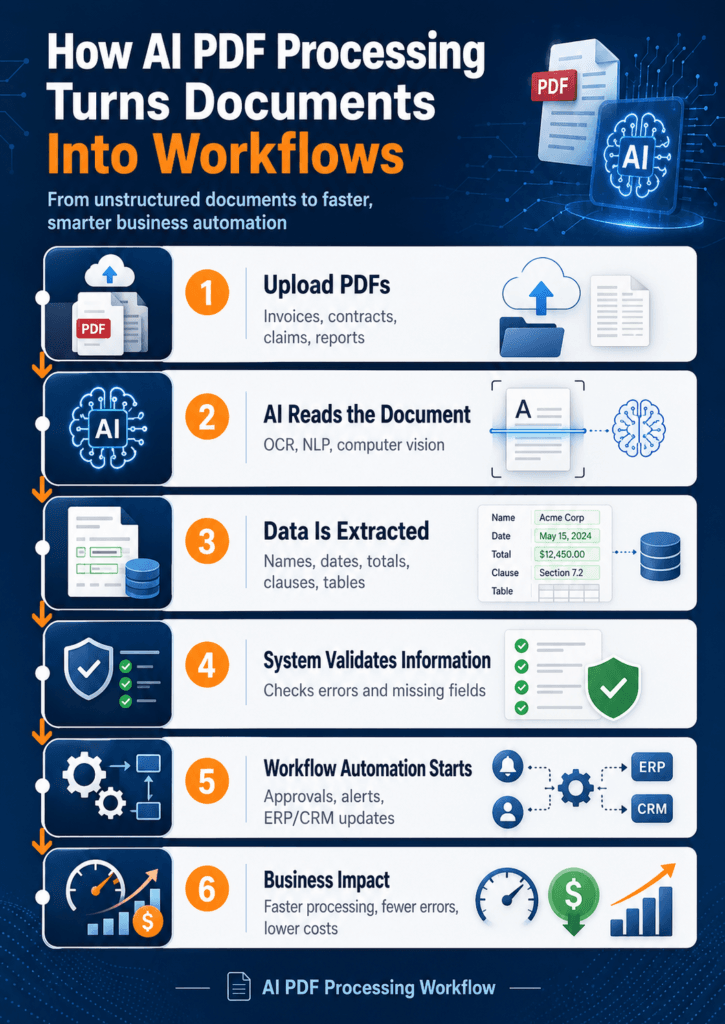
At its core, AI-powered PDF processing often called Intelligent Document Processing (IDP) combines several cutting-edge technologies to do something remarkably human: understand what is written in a document and act on it.
Where traditional OCR (optical character recognition) simply converts text in an image into digital characters, IDP goes several steps further. It understands context, recognises relationships between data points, classifies document types, and feeds clean structured data directly into your business systems.
The Technology Stack Behind IDP
Here is what is actually working under the hood when AI processes your PDFs:
- Optical Character Recognition (OCR) – Converts printed or handwritten content into machine-readable text, even from low-resolution scans
- Machine Learning (ML) – Learns from millions of documents to recognise patterns, adapt to new layouts, and improve continuously over time
- Natural Language Processing (NLP) – Understands the meaning and relationships between words, extracting key entities like names, dates, dollar amounts, and clauses
- Computer Vision – Analyses the visual layout of a document, identifying tables, headers, signatures, and form fields regardless of design
- Large Language Models (LLMs) – Summarise contracts, flag risks, generate compliance reports, and answer questions about document content in plain English
The result? Modern IDP platforms deliver up to 99% accuracy in data extraction from structured documents, while processing files up to 10 times faster than manual methods (Docsumo, 2025).
Real-World Use Cases That Are Delivering Results Today
This is not a futuristic technology. Businesses are deploying AI document processing right now across industries where PDFs are the lifeblood of operations.
Financial Services and Accounts Payable
Processing invoices, purchase orders, and expense reports manually is one of the most time-consuming tasks in finance. AI-powered IDP automatically extracts line items, vendor details, and totals, validates them against purchase orders, and routes approvals all without a human touching the document. The finance and accounting use case currently leads the entire Document AI market, and for good reason: the ROI is immediate and measurable.
Healthcare and Medical Records
Hospitals and clinics deal with an avalanche of handwritten notes, lab results, prescriptions, and billing forms. AI can transcribe handwritten clinical notes, extract patient data, and match information against billing codes dramatically reducing administrative burden and improving patient outcomes. Deep learning has now pushed handwriting recognition accuracy above 80%, making even legacy paper-based records processable.
Legal and Contract Management
Law firms and corporate legal teams are using AI to review contracts at scale. The system automatically identifies key clauses, flags unusual terms, highlights compliance risks, and generates plain-language summaries. What once took paralegal days to complete can now be done in minutes.
Insurance Claims Processing
AI systems can validate claims documents, cross-reference policy terms, detect anomalies that may signal fraud, and automatically route claims for approval or escalation. IDP can reduce document verification time by up to 85% (Docsumo, 2025), a game-changer for claims turnaround and customer satisfaction.
Real Estate and Mortgage
Title documents, property appraisals, income verification letters, and mortgage applications are all ripe for automation. AI extracts key financial data, checks for completeness, and feeds validated information straight into processing systems compressing what was a multi-week paper chase into a streamlined digital workflow.
The Numbers That Tell the Story
Still not convinced? Let the data speak:
| Metric | Statistic | Source |
|---|---|---|
| Cost reduction — basic automation | 20–30% | McKinsey |
| Cost reduction — AI-enhanced intelligent automation | Up to 70% | McKinsey |
| Data extraction accuracy with structured PDFs | Up to 99% | Docsumo, 2025 |
| Document verification time savings via IDP | Up to 85% | Docsumo, 2025 |
| Enterprises replacing legacy systems with AI document tools | 66% | Doxis IDP Survey, 2025 |
| Enterprises investing in AI to convert unstructured data | 60% | Forrester |
| Document AI market CAGR through 2030 | 13.5% | MarketsandMarkets |
| Unstructured data as share of all new enterprise data | 80–90% | Gartner / IDC |
What Makes Today's AI Document Processing Different?
A fair question we have had basic OCR for decades. What is actually new here?
The leap forward is context. Older systems could read text but had no idea what it meant. They were brittle, template-dependent, and constantly broke when a vendor changed their invoice layout. Today’s AI-powered systems are fundamentally different in three ways:
- They understand, not just read. NLP models can identify that “NET 30” in one contract and “payment due within thirty days” in another mean the same thing. They extract the intent, not just the characters.
- They adapt and learn. Machine learning models used in document automation improve in accuracy by 5 to 10% annually as they process new data (Docsumo, 2025). They get smarter with every document they handle.
- They take action. Modern agentic AI does not just extract data it routes approvals, triggers ERP updates, flags compliance issues, and generates summaries, all without waiting for a human to press a button.
By 2026, Gartner predicts that 70% of data preparation for AI projects will involve automated extraction tools. The infrastructure for truly intelligent document handling is being built right now.
How to Get Started: A Practical Roadmap
Ready to bring AI document processing into your organisation? Here is a straightforward approach that works regardless of your company size or industry:
- Identify your highest-volume, highest-pain document workflows first – invoices, contracts, claims, and onboarding forms are typically the best starting points
- Audit your current document quality – AI performs best on clearly scanned, digitally created PDFs; improving your input quality pays dividends immediately
- Choose a platform that fits your existing tech stack – look for solutions with open APIs and native integrations with your ERP, CRM, or accounting software
- Start with a pilot on a single document type – measure accuracy, turnaround time, and cost savings before scaling
- Build a human-in-the-loop review layer for edge cases – confidence scoring lets the system auto-process routine documents while flagging unusual ones for human review
- Plan for continuous improvement – modern AI systems learn from corrections, so your accuracy will improve steadily after deployment
The average time to deploy an enterprise-grade document automation solution has dropped to under eight weeks, thanks to pre-trained AI models and out-of-the-box templates. You no longer need a multi-year IT project to get results.
The Cenango Approach
At Cenango, we have spent over 20 years helping businesses across healthcare, insurance, finance, real estate, and legal services build smarter digital workflows. AI-powered document processing is one of the most impactful capabilities we deploy for our clients and we have seen first-hand how it transforms operations.
Whether you are processing thousands of insurance claims per week, managing a complex legal document library, or simply trying to eliminate the manual data entry that is slowing your team down, we can design and implement a tailored IDP solution that plugs directly into your existing systems.
Our conversational AI and intelligent document platforms do not replace your team they free your team to focus on the work that actually requires human intelligence: relationships, strategy, and judgment.
The Bottom Line
The age of the static PDF is over. Documents are no longer endpoints; they are the entry point to automated, intelligent workflows that save time, reduce errors, improve compliance, and drive better decisions.
With 66% of enterprises already replacing legacy document systems with AI-powered tools, and the global Document AI market set to nearly double by 2030, this is not a trend worth watching from the sidelines. The businesses investing in AI document processing today are the ones that will operate faster, leaner, and smarter tomorrow.
The technology is proven. The ROI is real. The only question is: how much longer can you afford to do it the old way?
📚 Sources — Social Media Description
- Docsumo — AI cuts document processing time by up to 85%
- Source: “50 Key Statistics and Trends in Intelligent Document Processing (IDP) for 2025”
- Publisher: Docsumo
- Published: February 27, 2025
- URL: https://www.docsumo.com/blogs/intelligent-document-processing/intelligent-document-processing-market-report-2025
- McKinsey — Cost savings of up to 70% with intelligent automation
- Source: McKinsey analysis on intelligent automation and AI cost reduction
- Referenced via: “33 Workflow Automation Statistics Shaping Business in 2025”, Custom Workflows AI, March 2025
- Note: McKinsey’s verified range is 20–30% for basic automation and 50–70% for AI-enhanced intelligent automation
- URL: https://customworkflows.ai/blog/business-workflow-automation-statistics
- MarketsandMarkets — Document AI market and industry use cases
- Source: “Document AI Market worth $27.62 billion by 2030”
- Publisher: MarketsandMarkets Press Release
- Published: November 10, 2025
- URL: https://www.prnewswire.com/news-releases/document-ai-market-worth-27-62-billion-by-2030–marketsandmarkets-302609795.html
- Gartner — Referenced in the “backed by research” claim
- Source: Gartner estimates on unstructured enterprise data (80–90%)
- Referenced via: “Unstructured Data Insights: Key Statistics Revealed”, Edge Delta
- URL: https://edgedelta.com/company/blog/what-percentage-of-data-is-unstructured
