





How Intelligent Document Processing Is Freeing Teams from the Paper Trail
Picture this: It’s Monday morning. Your team has 300 PDF invoices to process, a pile of insurance claim forms waiting for data entry, and a stack of contracts that need key clauses extracted — all before Friday. Sound familiar?
If you’ve ever spent hours manually copying data from PDFs into spreadsheets, you already know the pain. It’s repetitive, error-prone, and frankly, a frustrating way to spend your workday. The good news? Artificial intelligence is changing this story — fast.
In 2026, AI-powered document processing is no longer a “nice to have.” It’s fast becoming a competitive necessity. Let’s break down what’s happening, why it matters, and how your business can start benefiting today.
The Problem with Manual PDF Processing (It's Bigger Than You Think)
PDFs are everywhere. They’re the go-to format for invoices, contracts, medical records, legal briefs, insurance claims, and financial reports. But here’s the catch — PDFs were designed for reading, not for data extraction. Their static, layout-locked nature has historically made automated processing a nightmare.
So what happens? Humans step in. And that creates a cascade of problems:
- High error rates. Manual data entry consistently introduces mistakes — a transposed number, a missed field, a wrong date. These small errors can have big consequences.
- Slow turnaround. A team member manually processing a complex PDF document can take upwards of 7 minutes per file. Multiply that across hundreds of documents a day, and you’ve lost entire weeks of productivity.
- Scalability issues. When document volumes spike, your only option with a manual workflow is to throw more people at the problem.
- Staff burnout. Repetitive, low-value data entry tasks are a fast track to disengaged employees.
The numbers tell a sobering story. According to McKinsey research, intelligent automation can reduce operational costs by 20–30% while improving overall efficiency by over 40% — yet most organizations are still running largely manual operations.
Enter AI: Smarter, Faster, and Surprisingly Accurate
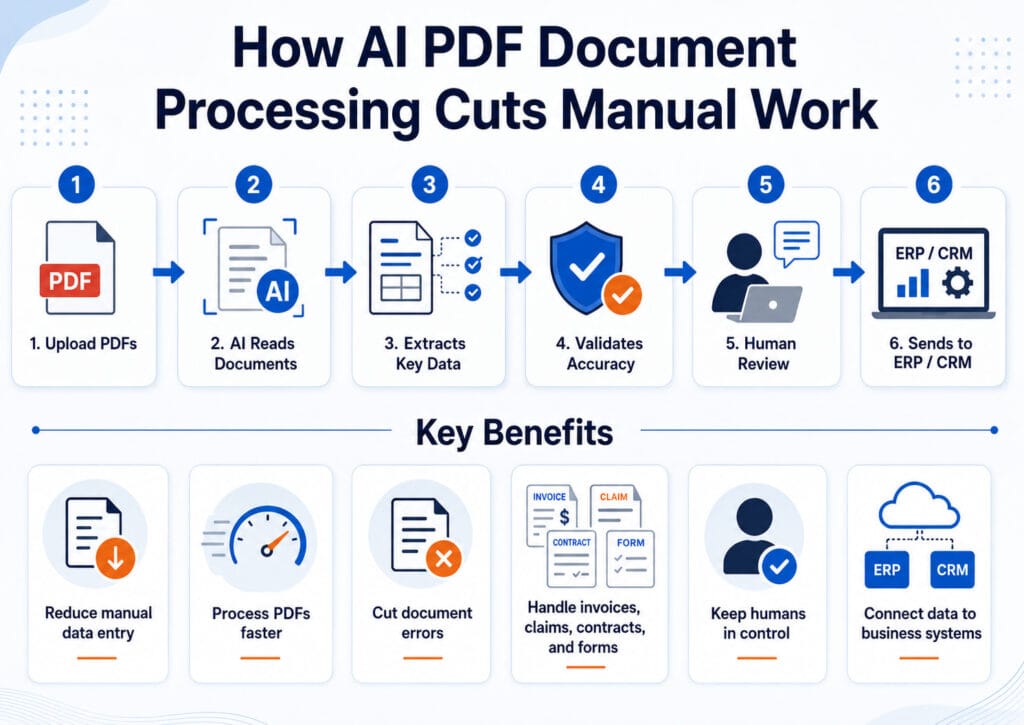
Artificial intelligence — specifically Intelligent Document Processing (IDP) — is rewriting the rules. IDP combines technologies like machine learning, natural language processing (NLP), and optical character recognition (OCR) to understand, extract, and validate data from PDFs automatically.
But this isn’t your grandfather’s OCR. Traditional OCR just converts an image of text into characters. Modern AI goes several steps further — it understands what it reads. It can tell the difference between a shipping address and a billing address, flag a missing signature on a contract, or identify a duplicate invoice before it causes a headache downstream.
Here’s what that looks like in practice:
1. Intelligent Data Extraction
AI models can identify and pull specific fields from PDFs — names, dates, dollar amounts, account numbers, addresses — even from complex, multi-page documents with inconsistent layouts. No templates. No rigid rules. Just smart extraction.
2. Document Classification
Got a mixed pile of invoices, purchase orders, and receipts? AI can automatically sort and route each document to the right workflow without human intervention.
3. Validation and Exception Handling
AI doesn’t just extract data — it checks it. It cross-references extracted values against business rules, flags anomalies, and only escalates to a human when something genuinely needs review. This “human-in-the-loop” model is the sweet spot between full automation and quality control.
4. Integration with Existing Systems
Modern IDP platforms plug directly into your ERP, CRM, or accounting software. Data extracted from PDFs flows straight into the systems your team already uses — no copy-paste required.
The Numbers Don't Lie: What AI Document Processing Delivers
The business case for AI-powered PDF processing is compelling. Here are verified statistics from recent industry research:
- 📉 Up to 75% reduction in manual labor costs linked to document handling
- ⏱️ 60–70% faster document processing times after implementing IDP solutions
- 💰 30–200% ROI in the first year of automation, primarily from labor cost savings (Docsumo IDP Market Report, 2025)
- 🎯 40% increase in employee productivity when manual data entry is replaced by automated workflows
- 📋 85% reduction in compliance-related errors for organizations using document automation
- 🏥 Healthcare providers save $20–$30 per patient by automating medical records and insurance forms
- ⚖️ Legal departments cut contract review times by 50–60% with document automation
- 🏦 In finance, automated processing reduces invoice errors by up to 37%, directly impacting profitability
One logistics company using an IDP solution reduced its per-document processing time from over 7 minutes to under 30 seconds — a reduction of more than 90%. That’s not incremental improvement. That’s transformation.
Real-World Use Cases Across Industries
AI PDF processing isn’t an abstract concept — it’s solving real problems in industries you know:
Healthcare
Medical practices and hospitals process mountains of paperwork — patient intake forms, insurance claims, referral letters, lab results. AI can extract and validate data from these documents instantly, reducing administrative burden and helping providers spend more time with patients. Healthcare organizations using advanced IDP solutions have reported a 40% increase in productivity while cutting order processing time by 30%.
Finance and Accounting
Invoice processing is one of the most impactful use cases. AI can receive a PDF invoice, extract line items and totals, match it against a purchase order, flag discrepancies, and route it for approval — all without a human touching it. Organizations using document automation have cut invoice processing cycle time from 12 days to under 3 days on average.
Legal Services
Law firms deal with contracts, discovery documents, and compliance filings daily. AI-powered tools can review contracts, extract specific clauses, flag potential risks, and summarize documents — tasks that once required hours of a lawyer’s time.
Insurance
Claims processing is notoriously document-heavy and slow. Insurance companies using AI automation have cut claims processing times by an average of 60%, delivering faster outcomes for customers and lower operational costs.
Real Estate
Lease abstraction, title documents, and property agreements all live in PDFs. AI tools can pull key data points — lease start dates, renewal clauses, rental escalation terms — from hundreds of documents in minutes.
The Market Is Moving — Quickly
If you’re wondering whether AI document processing is a passing trend, the market data says otherwise.
The global Intelligent Document Processing market was valued at approximately $1.9 billion in 2023 and is projected to reach $17.8 billion by 2032 — representing a compound annual growth rate of 28.9% (Market.us). By 2026, the IDP market is already crossing $4.38 billion and accelerating.
Large enterprises are leading the charge. According to a McKinsey global survey, 70% of organizations are actively piloting automation initiatives, with financial services institutions among the most aggressive adopters. And by 2026, it’s projected that 60% of back-office roles in large enterprises will be assisted by AI-driven document automation tools.
The message is clear: early adopters are pulling ahead. Those who wait risk being left with slower workflows, higher costs, and less competitive offerings.
Common Concerns — And Why They're Manageable
“Our documents are too inconsistent for AI.” This is one of the most common objections — and one of the most outdated. Modern AI models are trained on vast and varied document types. They handle inconsistency well, and they improve over time as they process more of your specific document formats.
“We’re worried about data security.” Legitimate concern. Look for IDP platforms with SOC 2 Type II compliance, end-to-end encryption, and role-based access controls. Many enterprise-grade solutions are built with data privacy as a foundation, not an afterthought.
“It will replace our staff.” The reality is quite different. AI handles the repetitive, low-value extraction work — freeing your team to focus on judgment-heavy tasks, client relationships, and strategic analysis. It’s a productivity amplifier, not a headcount replacement.
“Implementation sounds complex.” The latest generation of IDP tools is built for accessibility. Many offer low-code or no-code configuration, with drag-and-drop workflows and pre-built integrations. Your team can often be up and running within weeks, not months.
Getting Started: A Practical Roadmap
Ready to reduce the manual grind in your PDF workflows? Here’s a simple path forward:
- Audit your current document workflows. Identify where PDFs enter your business, how they’re processed, and where the biggest time sinks are.
- Prioritize high-volume, repetitive document types. Invoices, claims forms, and application documents are typically the best starting points — high volume, structured format, clear ROI.
- Evaluate IDP platforms. Look for solutions with proven accuracy rates, integration capabilities, human-in-the-loop validation, and strong security credentials.
- Pilot before you scale. Start with one document type or one department. Measure the results, refine the process, then expand.
- Track your ROI. Measure processing time, error rates, and staff hours saved. Use the data to build the business case for broader adoption.
The Bottom Line
Manual PDF processing is one of those business problems that feels normal until you see what automation actually looks like — and then it’s impossible to go back.
AI is making it possible to process documents faster, more accurately, and at a fraction of the cost. Whether you’re running a healthcare practice, a legal firm, a financial services company, or any business that lives and breathes documents, the technology is mature, proven, and accessible.
The question is no longer “Can AI handle our documents?”
It’s “How much longer can we afford to do this manually?”
