




By Cenango | AI & Digital Transformation
The world of business is changing fast. Customers want quick answers. They want help 24/7. They want smooth experiences.
That’s where AI chatbots come in. But here’s the big question: How do you pick the right company to build your chatbot? Let’s find out.
Why Conversational AI Is Growing So Fast
The numbers tell an amazing story. The global AI chatbot market hit $14.79 billion in 2025. By 2034, it will reach $82.46 billion. That’s growth of 21% each year.
Why is this happening? Three main reasons drive this growth.
First, businesses need better customer service. Second, AI keeps getting smarter. Third, customers prefer quick help over waiting. In fact, 82% of customers would rather chat with an AI bot than wait for a human.
This isn’t just hype. It’s a real shift in how businesses work. More than 78% of companies now use AI in some way. This shows AI chatbots have moved from nice-to-have to must-have tools.
Why You Need the Right Partner
Building a chatbot isn’t simple. You can’t just connect an API and call it done. The best companies bring real experience. They’ve solved the problems you’ll face.
Think about it this way. A demo that looks great might fail with real customers. Real use brings messy data. It brings odd questions. It brings busy times when everything must work well.
That’s where pro developers prove their worth. They turn demo success into real-world results.
What to Look For in AI Chatbot Companies
When choosing a partner, focus on these key points:
- Real Production Experience: Look for companies with live systems, not just demos. Ask about their work with real customers at scale. Request case studies and client references.
- Advanced AI Skills: The best companies don’t just use third-party tools. They fine-tune AI models. They use smart tech like RAG for better answers. They know when to use advanced models or simple ones.
- System Integration Skills: Your chatbot needs to work with your current systems. This includes your CRM, help desk, and databases. Companies with strong integration skills make this smooth and safe.
- Security First: Data security matters. Look for companies that focus on encryption, user permissions, and audit logs. Check if they follow rules like GDPR or HIPAA for your industry.
- Clear Success Metrics: The best partners track what counts. They measure chat completion rates, customer happiness, cost per issue solved, and ROI. They show you business results, not just tech specs.
Where AI Chatbots Work Best
AI chatbots work great in many fields. Different industries use them in unique ways:
- Retail and Online Stores lead with 21.2% of the market. They use AI for product tips, order tracking, and customer help. Many stores report big gains in customer satisfaction.
- Healthcare is growing fast. AI could save the U.S. healthcare system $150 billion each year by 2026. Uses include booking appointments, patient care, and clinic support. Chatbots saved healthcare $3.6 billion in 2023 alone.
- Banking and Finance use AI for fraud checks, account questions, and money advice. This helps banks serve more customers faster.
- Tech, Media, and Telecom are among the top three fields using AI agents in service work. They handle high chat volumes with ease.
Why Companies Invest in AI Chatbots
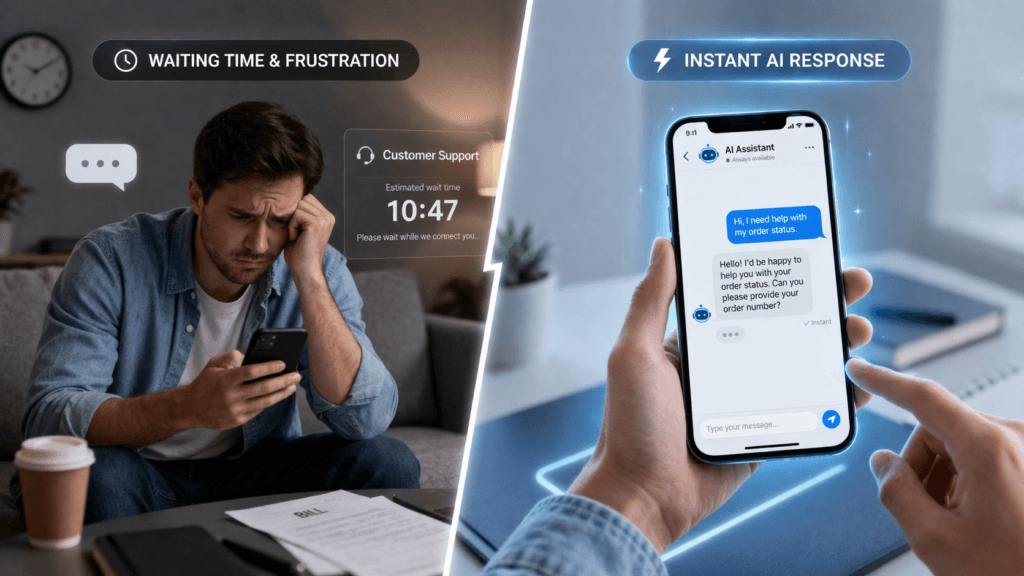
The benefits go beyond just answering questions. AI chatbots deliver real business results:
Lower Costs: Chatbots can cut support costs by up to 30%. This frees up your team to focus on complex issues. The savings add up fast, especially at scale.
Always Available: Your chatbot works 24/7. It doesn’t sleep or take breaks. It gives instant answers around the clock. This meets customer needs for immediate help.
Easy Scaling: One good chatbot can handle thousands of chats at once. Your human team can’t do that without adding more people. AI scales without limits.
More Revenue: AI chatbots don’t just save money—they make it. They qualify leads, answer sales questions, and guide shoppers to buy. This adds to your bottom line every day.
Common Mistakes to Avoid
Many companies make similar mistakes when choosing a chatbot partner. Here’s what to watch out for:
Don’t pick based on demos alone. A great demo doesn’t mean great results. Ask to see live systems with real customers. Check how they handle edge cases and peak loads.
Don’t ignore post-launch support. Your chatbot will need updates and fixes. Make sure your partner offers ongoing help. Ask about their support process before you sign.
Don’t skip the security review. Data breaches are costly. Check your partner’s security practices carefully. Make sure they meet your compliance needs from day one.
Platform or Custom Build: Which Is Right?
You’ll need to choose between a chatbot platform and custom development. Each has its place:
Platforms work best when your needs are standard and speed matters. They offer ready tools, templates, and quick setup. Many small to mid-size businesses start here.
Custom development makes sense for complex needs. Choose this if you need deep system integration or work in a regulated field. A basic project might take 6-10 weeks. Enterprise systems usually need 3-6 months.
The Market Leaders
The AI chatbot space has both big tech giants and specialized firms. Major players include Google, Microsoft, Amazon Web Services, and IBM. They bring huge resources and strong platforms.
Smaller companies focus on specific fields or uses. They offer deep know-how in their areas. Some excel in retail, others in healthcare or finance.
Recent partnerships show where the market is going. For example, Kore.ai partnered with Microsoft in May 2025 to speed up enterprise AI use. These teams combine AI skills with cloud power, helping businesses launch solutions at scale.
Questions to Ask Before You Sign
Don’t rush. Ask these key questions:
- Can you show me live chatbots you’ve built, not just demos?
- How do you handle odd questions that weren’t in the training data?
- What’s your approach to security and data privacy? Do you follow rules for my industry?
- How will you integrate with our current systems?
- What happens after launch? Do you provide ongoing support and updates?
- What metrics do you track to measure success? How will we know if it’s working?
The Future Is Here
We’re seeing a big shift. Simple chatbots are becoming smart AI agents that can take action. By 2029, experts predict these AI agents will solve 80% of common service issues on their own.
These systems won’t just answer questions. They’ll complete tasks, make decisions, and reach out when needed.
Companies that succeed with AI aren’t just buying tech. They’re rethinking how they talk to customers. They know that 81% of businesses plan to invest in AI for customer service in 2025 and beyond. The question isn’t whether to use AI, but how to do it right.
Your Next Steps
Finding the right AI chatbot company isn’t about the biggest name. It’s not about the best demo. It’s about finding a partner who gets your business needs. Look for proven results. Find someone who can grow with you.
Start by defining success for your business. Do you want to cut support costs? Boost customer satisfaction? Generate more leads? Once you know your goals, you can pick partners based on their ability to deliver those results.
The AI chatbot market is growing at 23.7% each year for good reason—it works. Businesses that use it well see real improvements in efficiency, customer happiness, and revenue. The key is choosing a trusted partner who can turn AI promise into real business results.
Your customers are ready for better, faster, more personal service. Are you ready to deliver?
Market Size & Growth Statistics
$14.79 billion (2025) and $82.46 billion (2034) with 21% annual growth:
- Fortune Business Insights – Conversational AI Market Size, Share | Statistics [2026-2034]
- URL: https://www.fortunebusinessinsights.com/conversational-ai-market-109850
23.7% CAGR (Alternative market projection):
- Grand View Research – Conversational AI Market Size, Share | Industry Report, 2030
- URL: https://www.grandviewresearch.com/industry-analysis/conversational-ai-market-report
Customer & Business Adoption
82% of customers prefer chatbots over waiting:
- Tidio Research (cited in Nextiva)
- URL: https://www.nextiva.com/blog/conversational-ai-statistics.html
78% of companies use AI:
- Knock AI – Best AI Chatbots 2026: Full Comparison & Buyer’s Guide
- URL: https://www.knock-ai.com/blog/best-ai-chatbots
81% of businesses plan to invest in AI for customer experience:
- Nextiva – 50+ Conversational AI Statistics for 2026
- URL: https://www.nextiva.com/blog/conversational-ai-statistics.html
Industry-Specific Data
Retail and e-commerce: 21.2% market share:
- Fortune Business Insights – Conversational AI Market Size, Share | Statistics [2026-2034]
- URL: https://www.fortunebusinessinsights.com/conversational-ai-market-109850
Healthcare: $150 billion potential annual savings by 2026:
- Fortune Business Insights – Conversational AI Market Size, Share | Statistics [2026-2034]
- URL: https://www.fortunebusinessinsights.com/conversational-ai-market-109850
Healthcare: $3.6 billion saved in 2023:
- Fortune Business Insights (cited in Nextiva)
- URL: https://www.nextiva.com/blog/conversational-ai-statistics.html
Top three industries (Tech, Media, Telecom):
- McKinsey (cited in Nextiva)
- URL: https://www.nextiva.com/blog/conversational-ai-statistics.html
Cost Savings & ROI
30% cost reduction in customer support:
- Thunderbit – AI Chatbots Stats and Numbers in 2026
- URL: https://thunderbit.com/blog/ai-chatbot-stats
Future Predictions
80% of service issues resolved autonomously by 2029:
- Gartner (cited in multiple sources including Skywork AI)
- URL: https://skywork.ai/skypage/en/chatbot-companies-guide/2029027589305294848
85% of customer service leaders exploring AI by 2025:
- Gartner (cited in GoGloby)
- URL: https://gogloby.com/insights/conversational-ai-chatbot-development-companies/
Partnership Information
Kore.ai and Microsoft partnership (May 2025):
- MarketsandMarkets – Conversational AI Market Size, Statistics, Growth Analysis & Trends
- URL: https://www.marketsandmarkets.com/Market-Reports/conversational-ai-market-49043506.html
Development Timelines
6-10 weeks for basic projects, 3-6 months for enterprise:
- GoGloby – 10 Best Conversational AI Chatbot Development Companies in 2026
- URL: https://gogloby.com/insights/conversational-ai-chatbot-development-companies/
Regional Market Data
North America: 33.62% market share (2025):
- Markets and Markets (cited in Nextiva)
- URL: https://www.nextiva.com/blog/conversational-ai-statistics.html
Additional Reference Sources:
- Springs Apps – Conversational AI Trends In 2025-2026 And Beyond
- URL: https://springsapps.com/knowledge/conversational-ai-trends-in-2025-2026-and-beyond
- K2view – Conversational AI market: Transforming business at an explosive rate
- URL: https://www.k2view.com/blog/conversational-ai-market/
SOURCES FOR KEY INSIGHT
- Market growth: 21% annually, $14.79B (2025) to $82.46B (2034)
- Source: Fortune Business Insights
- https://www.fortunebusinessinsights.com/conversational-ai-market-109850
- 82% of customers prefer chatbots over waiting for human representatives
- Source: Tidio (cited in Nextiva)
- https://www.nextiva.com/blog/conversational-ai-statistics.html
- 30% cost reduction in customer support
- Source: Thunderbit
- https://thunderbit.com/blog/ai-chatbot-stats
- Healthcare saved $3.6 billion in 2023
- Source: Fortune Business Insights (cited in Nextiva)
- https://www.nextiva.com/blog/conversational-ai-statistics.html
- 80% of customer service issues resolved autonomously by 2029
- 81% of businesses plan to invest in AI for customer experience
Sources for Corrected Key Insight
AI Model Costs (Small Percentage of Total)
“$200-600/month for API fees even at high volume”
- Salt Techno AI – AI Chatbot Development Cost 2026
- Quote: “A chatbot handling 10,000 conversations per month (averaging 4 exchanges per conversation) uses roughly 20 to 40 million tokens per month. With GPT-4o, that costs $200 to $600/month in API fees.”
Integration Costs (20-50% of Budget)
“Integration costs can add 20-50% to overall budget”
- Crescendo AI – How Much Do AI Chatbots Cost
- Quote: “Integration costs can add 20–50% to the overall budget. Developing APIs for each system connection typically costs between $5,000 and $25,000.”
“Integration costs: $5,000-30,000”
- Salt Techno AI – AI Chatbot Development Cost 2026
- Quote: “The total integration cost for a typical mid-market chatbot (3 to 5 systems) ranges from $5,000 to $15,000. For enterprise chatbots with 8 to 10+ integrations, expect $15,000 to $30,000 in integration work.”
Data Preparation (50-70% of Budget – NOT 20-30%)
“Winning programs budget 50-70% for data readiness”
- Salt Techno AI – AI Chatbot Development Cost 2026
- Quote: “Gartner warned in February 2025 that organizations will abandon 60% of AI projects unsupported by AI-ready data through 2026. The winning programs earmark 50-70% of timeline and budget for data readiness.”
“Data preparation significantly underestimated”
- Softermii – AI Agent Development Cost 2026
- Quote: “The data preparation piece is the one clients consistently underestimate. Your data is never as clean as you think it is… AI implementation costs increased 89% between 2023 and 2025 (Glean), and data work is a major reason.”
Pricing Escalation ($50 to $500-3,000/month)
“Base pricing vs actual costs”
- Kaily AI – AI Chatbot Pricing in 2026
- Verified pricing tiers: $0-50/month basic, $30-150/month small business, $500-1,500/month mid-market
- Chatarmin – Chatbot Pricing 2026
- Quote: “Professional SaaS solutions with real AI run €500–2,500/month, plus setup (€2,000–15,000)”
Cost Reduction Results (30%)
“30% cost reduction in support costs”
- Thunderbit – AI Chatbots Stats 2026
- Previously verified source from original blog