




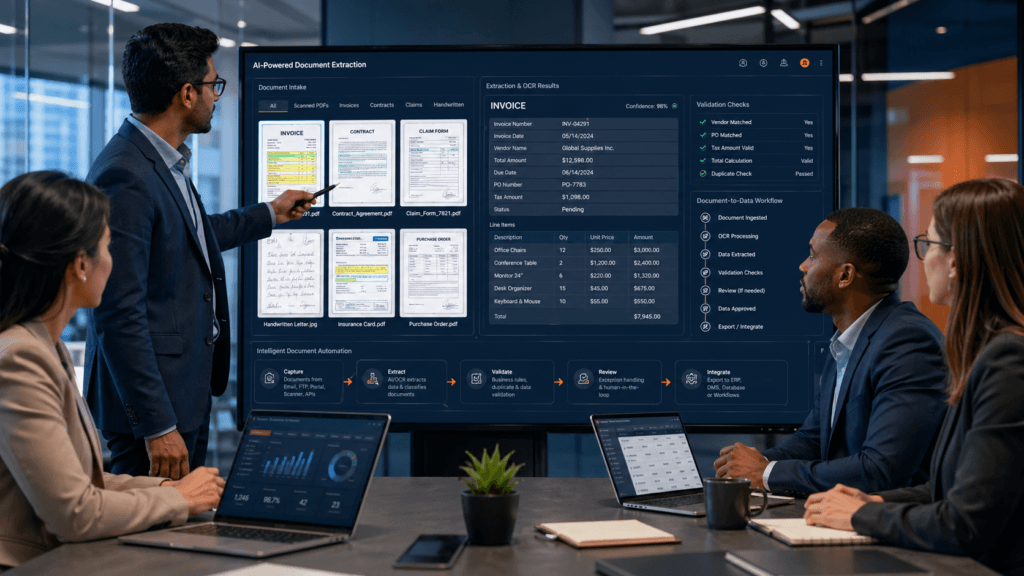
Picture this. Your team is buried in PDFs. Contracts. Invoices. Patient records. Claims forms. And someone still has to open each one — read it — and type the data into your system by hand.
Sound familiar? You’re not alone.
PDFs have been the backbone of business for decades. But getting the data out of them has always been a headache. The good news? AI has changed everything — and the results are stunning.
Let’s dig in.
The Problem: PDFs Were Never Built for Easy Data Extraction
Not all PDFs are the same. They come in two very different types. Both have been painful to work with at scale.
Digital (native) PDFs are created straight from software. Think Word docs or spreadsheets saved as PDFs. They contain real, searchable text. Easy for a human to copy-paste. But automating that process across thousands of files? That’s where things fall apart fast.
Scanned PDFs are a whole different story. These are paper documents that were photocopied and saved as image files. There’s no text layer — just pixels. Think old contracts, handwritten forms, or medical records. Getting useful data out of these without the right tools is like reading through frosted glass.
Now multiply both of these across millions of documents. Add multiple departments, languages, and file formats. That’s the daily reality for most large businesses today.
Why AI Is the Answer
Old-school OCR (Optical Character Recognition) was the first fix for scanned files. It worked well on clean, simple text. But it struggled with poor scan quality, odd fonts, complex layouts, and handwriting.
Modern AI goes far beyond that.
Today’s AI-powered tools combine OCR with machine learning, NLP , and deep learning. They don’t just read documents — they understand them. They grasp context, structure, and meaning. Just like a smart human would.
The numbers back this up. AI-driven text recognition improves document processing accuracy by 41% compared to legacy manual systems. That’s not a small upgrade. That’s a complete game-changer.
The Market Is Exploding — Here’s Why
Still think this is just a trend? Take a look at the data.
The global Intelligent Document Processing (IDP) market was valued at USD 10.57 billion in 2025. It’s set to reach USD 91.02 billion by 2034. That’s a CAGR of 26.20%.
Healthcare, finance, legal, insurance, and logistics companies are all moving fast. They need to. Data volumes are growing at a staggering rate. Right now, 74% of enterprises store more than 5 petabytes of unstructured data — up 57% from 2024.
Manual extraction can’t keep up. AI can.
How It Works: Digital vs. Scanned PDFs
Let’s look at how AI handles each document type.
For Digital PDFs
When a PDF is natively digital, AI focuses on structure and meaning. It spots headers, tables, line items, and data fields. Then it maps that data straight to your target system.
Even when layouts change — say, 500 vendors sending invoices in 500 different formats — the AI adapts. It learns. It normalises. It gets smarter over time.
AI-powered tools can hit data extraction accuracy of up to 99% in structured documents. For unstructured data, NLP models deliver 85–90% accuracy on average. That’s a huge leap over manual processing.
For Scanned PDFs
This is where AI really shines. Modern IDP platforms use neural networks to handle even the messiest files.
Here’s what the AI does, step by step:
- Pre-processes the image — corrects skew, removes noise, and boosts contrast
- Applies smart OCR — reads context, not just characters
- Recognises handwriting — deep learning has pushed handwriting accuracy past 80%
- Validates the data — cross-checks results against business rules before moving on
Even old, faded scanned files can be processed at scale. That would have needed a full data entry team just a few years ago.
The Real-World Impact: Speed, Savings, and Less Stress
Let’s get practical. What does this mean for your business?
AI can cut document processing time by 50% or more. One logistics company cut processing time from over 7 minutes per file to under 30 seconds. That’s a 90%+ drop.
The cost savings are real too. Businesses report 30–200% ROI in the first year of automation. Cost cuts of up to 70% are common.
And accuracy? AI reduces error rates by over 52%. For healthcare and insurance, where one wrong data point can trigger a compliance issue or a costly claim dispute, that matters a lot.
AI PDF Extraction infographic showing how PDFs turn into structured business data
Who Is Leading the Way?
AI-powered PDF extraction is taking off across many sectors. Here’s a quick look at who benefits most:
Healthcare — Patient records, lab reports, and referral forms get processed fast. Faster data means better care and less admin burden.
Insurance and Finance — Claims, loan apps, and KYC docs are automated end to end. The BFSI sector accounts for 37.3% of IDP market adoption worldwide.
Legal Services — Contracts and discovery files are reviewed at speed. One firm cut RFP response time from three weeks to one — and handled 400% more RFPs as a result.
Real Estate — Title docs, leases, and old scanned property records are now easy to process and search.
What to Look for in an AI Extraction Tool
Not all AI document platforms are equal. Here’s what truly matters when picking one:
Accuracy across document types — Can it handle both clean digital PDFs and messy scanned files? Does it work on tables, handwriting, and complex layouts?
Scalability — Can it process thousands of files at once without slowing down?
Integration — Does it plug into your ERP, CRM, or workflow tools ? Cloud-based platforms reduce costs by 30–40% vs. on-premise options.
Human review capability — Can your team step in on edge cases to keep the model sharp?
Security and compliance — This is non-negotiable in healthcare, finance, and legal work.
The Bottom Line: Work Smarter, Not Harder
Manual PDF data entry is on its way out. And not a moment too soon.
78% of enterprise executives have listed document automation as a top digital priority. The question is no longer if you should invest in AI-powered extraction. It’s how fast you can get there.
Whether your files are crisp digital PDFs or faded scanned paper from 30 years ago, AI can extract what you need — fast, accurate, and at scale. The businesses moving on this now will outpace those that wait.
Stop drowning in PDFs. Start turning documents into decisions.
Want to see what Cenango can do for your document workflows? Book a Free Consultation — let’s talk about AI and what it can do for your business today.
Sources
Claim 1 — 99% extraction accuracy:
SenseTask — 75 Document Processing Statistics for 2025
AI-powered document processing achieves data extraction accuracy rates of up to 99% in structured documents. Sensetask
Claim 2 — 52% error rate reduction:
Docsumo — 50 Key Statistics and Trends in Intelligent Document Processing 2025
IDP can reduce error rates by over 52%, dramatically reducing mistakes in data extraction and entry. Docsumo
Claim 3 — 50%+ processing time reduction:
Docsumo — 50 Key Statistics and Trends in Intelligent Document Processing 2025
IDP can cut document processing time by 50% or more, significantly accelerating workflows. Docsumo
Claim 4 — $91 billion IDP market by 2034:
Fortune Business Insights — Intelligent Document Processing Market Size & Trends
The global IDP market was valued at USD 10.57 billion in 2025 and is projected to grow to USD 91.02 billion by 2034, at a CAGR of 26.20%. Fortune Business Insights
