




By Cenango | AI & Digital Transformation
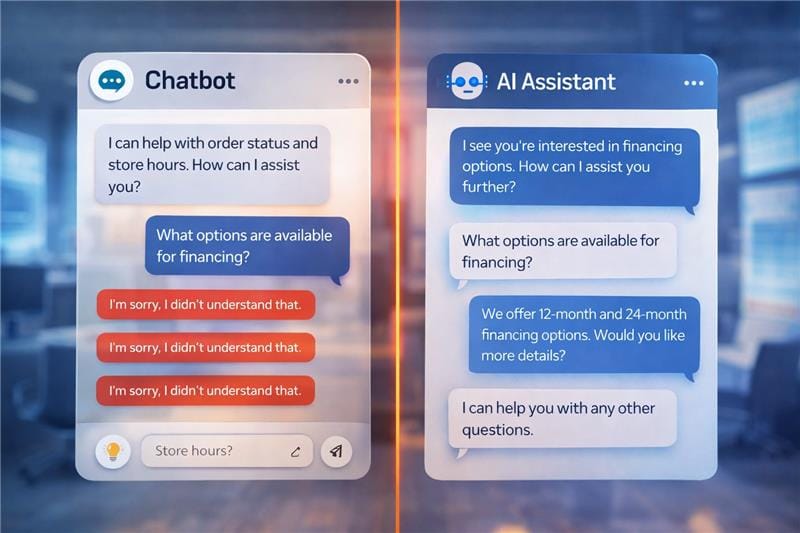
You’ve chatted with a bot online before. Maybe you tracked a package. Maybe you asked about store hours. Or maybe you got three “I’m sorry, I didn’t understand that” replies in a row — and gave up in frustration.
Sound familiar? You’re not alone.
Here’s something most people don’t realize. Not all bots are the same. There’s a big gap between a basic chatbot and what we call Conversational AI. That gap matters — a lot — for your business, your customers, and your bottom line.
Let’s break it down in plain, simple terms.
What Is a Chatbot?
A chatbot is a program built to reply to messages. That’s the short version.
It works by following rules. The user says X. The bot says Y. Think of it like a very detailed script. The bot doesn’t think. It doesn’t learn. It just matches words to set answers.
This is called rule-based logic. It works well for simple tasks. Ask about store hours? Easy. Check an order number? No problem. But go even slightly off-script? The bot gets lost — fast.
Basic chatbots are still useful in the right setting. They’re cheap to build. They run all day and night. They handle high volumes with no effort. For repeat, simple tasks, they get the job done.
Here’s where chatbots shine:
- Answering common questions (FAQs)
- Routing users to the right team
- Checking basic order or delivery status
- Booking simple, pre-set time slots
But the moment a chat gets real — messy, personal, and complex — a basic chatbot hits a wall. It can’t adapt. It can’t think. And it can’t help.
That’s where things get interesting.
What Is Conversational AI?
Conversational AI is a whole new level.
Instead of a script, it uses Natural Language Processing (NLP) and Machine Learning (ML) to understand what people mean. It reads intent, not just words. It tracks the full chat. And it gets better over time.
Here’s a simple way to think about it. A chatbot is like a vending machine. Press a button. Get a fixed result. Conversational AI is like a skilled barista. You say, “Something warm, not too strong, a little sweet” — and they get it right every time.
That’s the power of real understanding.
Here’s what makes Conversational AI stand out:
- Natural Language Understanding (NLU): It grasps meaning, not just keywords
- Context memory: It tracks the whole chat, not just the last message
- Sentiment awareness: It picks up on frustration or excitement — and adjusts its tone
- Ongoing learning: It gets smarter with each new chat
- Multi-channel support: It works across chat, voice, text, email, and more
It doesn’t just respond. It connects.
Key Differences at a Glance
| Feature | Traditional Chatbot | Conversational AI |
|---|---|---|
| Intelligence | Rule-based, scripted | AI-powered, adaptive |
| Language Understanding | Keyword matching | Intent and context |
| Learning Ability | Static | Learns and improves |
| Conversation Flow | Linear, rigid | Dynamic and natural |
| Handles Complexity | Limited | Yes |
| System Integration | Basic | Deep system links |
| Best For | Simple, repeat tasks | Complex, multi-turn chats |