



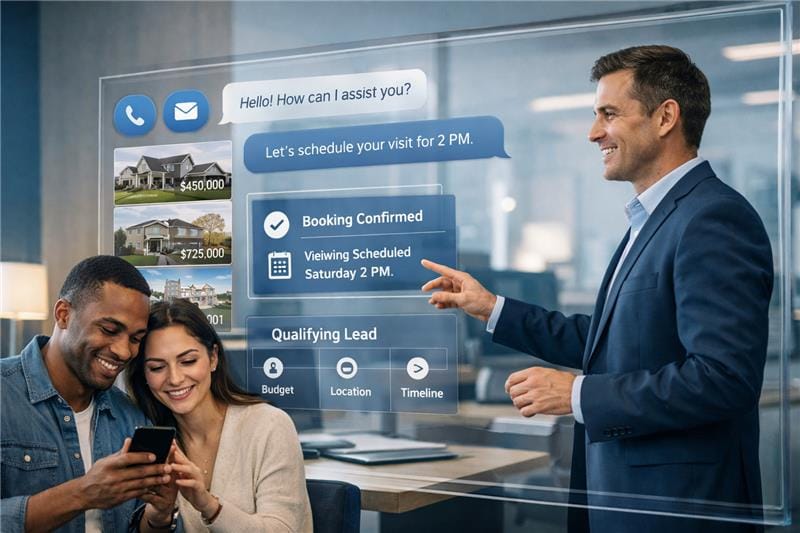
Real estate professionals face mounting pressure in today’s digital-first market. Online inquiries pour in at all hours. Phone calls come during dinner time. Weekend property viewings generate follow-up questions on Monday morning.
Meanwhile, response times lag dangerously behind buyer expectations.
According to a 2024 Homeflow study, 48% of sales inquiries go completely unanswered. The average response time sits at nearly four business hours. Even more concerning, leads become customers 21 times more frequently when contacted within five minutes compared to 30 minutes later.
With 96% of home buyers now searching online for properties, the stakes have never been higher. Additionally, 50% of buyers use mobile devices during their search, expecting instant responses regardless of time or location.
This is where conversational AI for real estate becomes essential. The technology transforms how brokerages engage with digital-first buyers.
Modern AI solutions handle the complete inquiry-to-appointment journey. They work tirelessly while agents focus on what they do best: closing deals.
Conversational AI for real estate isn’t optional anymore. It’s the foundation of competitive lead engagement.
Who Searches for Conversational AI Solutions
Several key decision-makers actively seek conversational AI for real estate operations today.
Real estate agents and brokers need technology that handles lead volume without adding staff. They want systems that work while they focus on property showings and closings.
Brokerage owners look for scalable solutions that reduce operational costs. They need technology that improves agent productivity across multiple locations.
Property developers managing large-scale launches require systems that handle inquiry spikes. Marketing managers seek tools that qualify leads before human intervention.
Finally, PropTech and IT decision-makers evaluate platforms that integrate with existing systems. They prioritize solutions that deliver measurable ROI within months, not years.
The Problem with Traditional Lead Handling
Slow Response Creates Lost Revenue
Website forms sit unattended for hours. Visitors fill out contact information and then wait. Many never hear back at all.Phone calls during evenings and weekends go to voicemail. By Monday morning, those hot leads have already contacted three other agents.WhatsApp messages and emails pile up in inboxes. Manual responses take time agents don’t have.CRM Systems That Don’t Connect
Data entry happens manually, often days after initial contact. Lead scoring requires human judgment, creating inconsistency across teams.Follow-up sequences run on rigid schedules, not buyer behavior. Marketing automation, website activity, and phone systems operate in silos.Without integration, critical information gets lost. Agents waste time searching for conversation history across multiple platforms.Email platforms don’t sync with phone systems. Website chat logs exist separately from CRM records.This fragmentation creates duplicate work. Teams struggle to maintain accurate, up-to-date lead information.Operational Gaps That Cost Money
High inquiry volumes overwhelm small teams. Hiring call center staff increases overhead significantly.Customer experience varies wildly depending on which agent responds. Language barriers limit market reach, especially in diverse metropolitan areas.Traditional systems simply can’t scale during property launches or major campaigns. The busiest times become the most inefficient.Peak periods expose every weakness. New construction projects generate hundreds of simultaneous inquiries.Manual processes buckle under pressure. Quality suffers precisely when first impressions matter most.
Why Decision-Makers Search for Conversational AI
Business leaders recognize that traditional methods no longer work in today’s competitive environment.
They need 24/7 response capability without night shift employees. Faster lead qualification reduces time wasted on unqualified prospects.
Automatic appointment booking eliminates phone tag and scheduling friction. Lower operational costs improve profit margins across the organization.
Most importantly, modern buyers expect a competitive digital experience. Providing anything less means losing business to tech-savvy competitors.
Market dynamics have fundamentally changed. Buyers research extensively before making contact. When they finally reach out, they expect immediate answers.
Delayed responses signal disorganization or disinterest. Prospects interpret slow follow-up as a preview of future service quality.
Competition intensifies daily. Other brokerages already leverage AI advantages. Staying with manual processes means falling further behind.
How AI Solves Core Real Estate Challenges
Instant Lead Response Across All Channels
AI assistants respond to website visitors within seconds, not hours. They handle WhatsApp messages, SMS inquiries, and phone calls simultaneously.This immediate engagement captures leads while interest peaks. No more lost opportunities due to delayed responses.Automated Lead Qualification
AI virtual assistants for property businesses ask the right questions systematically. They gather budget range, preferred locations, and property types without feeling pushy.Understanding timeline urgency helps prioritize follow-up efforts. Smart routing then connects qualified leads to the most appropriate agent based on expertise.Pre-qualification saves significant time. Agents receive complete buyer profiles before making contact. They know exactly which properties to discuss.The system identifies serious buyers from casual browsers. High-intent prospects get immediate attention. Lower-priority leads enter nurture sequences automatically.Seamless CRM Integration
Every conversation automatically creates or updates lead records. Complete conversation history stores in one central location.Agents access full context before making contact. No more asking prospects to repeat information they’ve already provided.Automated Appointment Scheduling
Real-time calendar synchronization enables instant booking. Prospects schedule property viewings without human coordination.Confirmation messages and reminders reduce no-shows. Agents arrive prepared with relevant property information.Multilingual Support That Never Sleeps
Voice AI for real estate operates continuously, every day. Language barriers disappear with multilingual conversation capabilities.International buyers receive the same quality service as local prospects. This expands market reach without hiring multilingual staff.
Outcomes That Drive Business Growth
Implementing conversational AI for real estate delivers measurable results across all key metrics.
Lead conversion rates improve significantly when response time drops from hours to seconds. Studies show 100x higher connection rates with five-minute responses versus hour-long delays.
Customer experience scores increase when prospects receive instant, helpful responses. Satisfaction ratings climb as frustration from waiting disappears.
Agent workload decreases as AI handles initial qualification and information gathering. This allows agents to focus on high-value activities like property showings and negotiations.
Operations scale efficiently during peak periods. The system handles 100 inquiries as easily as 10, maintaining consistent quality throughout.
Revenue per agent typically increases by 20-40% within six months. Higher lead volume combines with better qualification for dramatic improvements.
Customer acquisition costs decrease as automation replaces expensive manual processes. Marketing budgets stretch further with higher conversion efficiency.
Essential Features for Real Estate AI Solutions
Buyers evaluate specific capabilities when selecting conversational AI for real estate platforms.
Combined AI chatbot and voice bot functionality ensures channel flexibility. Property recommendation engines match prospects with suitable listings.
CRM and MLS integration eliminates duplicate data entry. Analytics dashboards provide visibility into lead sources and conversion patterns.
Compliance features protect sensitive customer data. Omnichannel support meets buyers where they prefer to communicate.
Before and After: A Typical Implementation
Traditional operations struggle with manual processes. Agents answer phones individually while trying to conduct showings.
Follow-ups happen inconsistently. Many leads slip through cracks during busy periods.
After implementing AI, the transformation is dramatic. Initial inquiries receive instant responses with relevant property information.
Qualification happens automatically. Calendars fill with pre-scheduled appointments featuring genuinely interested prospects.
Agents focus entirely on face-to-face interactions. Conversion rates increase by 30-50% within the first quarter.
Response time drops from hours to under 60 seconds. Lead volume capacity doubles without adding headcount.
The Business Case for AI Adoption
Automated lead qualification with conversational AI for real estate is no longer a luxury feature.
It represents a fundamental shift in how properties get sold. Manual processes simply cannot compete with AI-powered speed and consistency.
Buyers expect instant responses. Competitors already use these tools.
Businesses that modernize lead engagement win more listings. They close more transactions. They operate more profitably.
Ready to Transform Your Lead Engagement?
The real estate market rewards quick adopters of proven technology. Conversational AI for real estate has moved beyond the experimental phase.
Leading brokerages already rely on these systems daily. They’ve replaced outdated manual processes with automated intelligence.
Contact us today to explore how AI can transform your lead engagement process. Schedule a personalized demonstration to see the technology in action.
Discover why top-performing real estate teams choose AI-powered lead engagement over traditional methods. Your next competitive advantage is one conversation away.
Data Sources:
All statistics verified from recent industry reports (2024-2025) including research from Gartner, CMSWire, Markets and Markets, Sprinklr, LiveAgent, and Digital Minds BPO.