



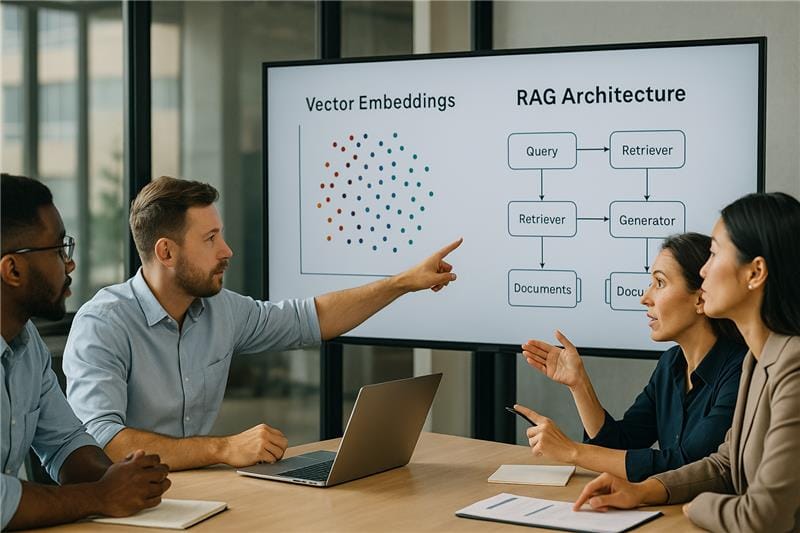
If you’ve been exploring AI and large language models, you’ve probably encountered Retrieval-Augmented Generation, or RAG. It’s a powerful method that gives AI access to external knowledge.
However, RAG only works at its best when paired with the right data system. This is where vector databases for RAG become absolutely essential.
Traditional Database Challenge
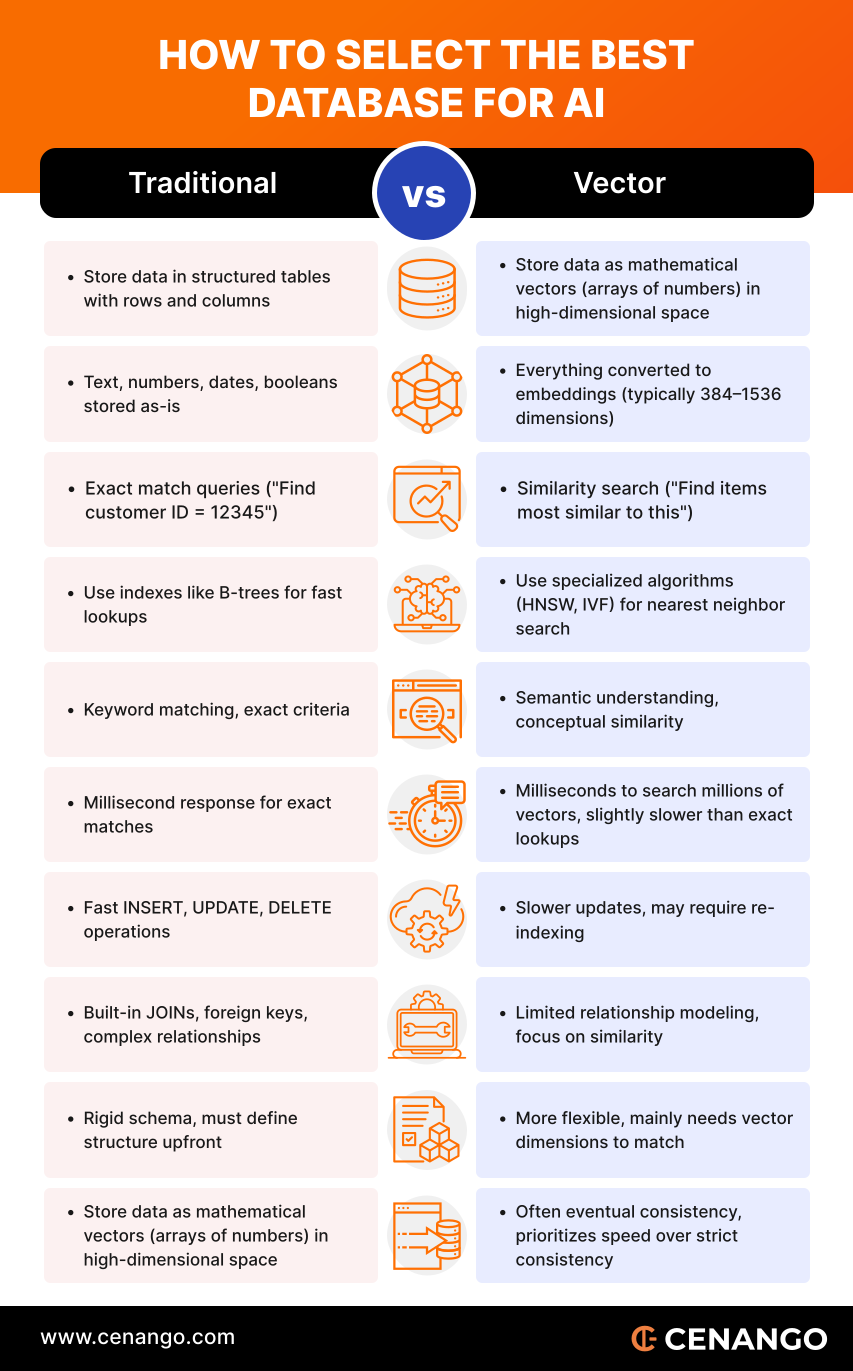
For decades, traditional relational databases have been the backbone of software systems. They excel at storing structured data in tables, maintaining relationships, and delivering exact-match queries efficiently.
For example, they handle queries like:
- “Show me customer ID 12345”
- “Find all orders from January 2024”
Where Traditional Systems Excel
Relational systems perform brilliantly with indexes like B-trees to locate data quickly. Therefore, they’re ideal for:
- Transaction processing
- Inventory management
- Finance records
- User account systems
Critical Limitation
However, traditional databases have a fundamental weakness: they cannot understand meaning. Instead, they only match exact text. Consequently, they cannot recognize when two sentences express similar ideas using different words. For AI systems, this becomes a significant limitation.
How Vector Databases Work Differently
In contrast to traditional databases, vector databases for RAG use embeddings instead of rows and columns. These embeddings represent meaning as high-dimensional vectors.
Understanding Embeddings
When you convert text into an embedding, something remarkable happens:
- Similar ideas appear close together in vector space
- Different wording still matches semantically
- Concepts become searchable by their actual meaning
For instance, consider these sentences:
“I love sunny weather”
“Beautiful day with clear skies”
Although they use completely different words, their vectors sit near each other because they share similar meaning.
Search Technology Behind It
Moreover, vector databases for RAG use specialized algorithms like HNSW (Hierarchical Navigable Small World) or IVF (Inverted File Index) to rapidly find “nearest neighbors.” As a result, searches work based on similarity rather than exact keyword matches.
Why Vector Databases for RAG Matter

RAG improves AI responses by retrieving useful context from your knowledge base. To do this, the system must find the most relevant information—not just keyword matches.
If a user says:
“My app crashes when I try to export files.”
Traditional keyword searches may miss articles like:
- “Resolving Application Freezes During File Operations”
- “Export Feature Stability Issues”
These documents do not share the same words, but their meaning is relevant.
With vector databases for RAG, the user’s question is turned into an embedding. The system retrieves documents with the closest semantic meaning, even when phrasing is different. This is what makes RAG powerful.
The Role of Semantic Embeddings
Embeddings capture meaning across hundreds or thousands of dimensions. Models such as:
- OpenAI’s text-embedding-ada-002
- Sentence-Transformers
learn to understand:
- Synonyms
- Rephrased sentences
- Conceptual links
Embedding models create a “map of meaning,” and vector databases navigate this map efficiently.
Real-World Impact
Vector search and RAG are now transforming many industries. Examples include:
- Companies retrieving years of internal documentation
- Legal teams discovering relevant cases by similarity
- Healthcare systems finding medical studies using conceptual search
Modern vector databases scan millions of embeddings in milliseconds and scale easily. This makes them ideal for modern AI workflows.
The Bottom Line
Traditional and vector databases serve different purposes.
Traditional Databases
- ✔ Ideal for structured data
- ✔ Fast exact-match queries
- ✔ Best for transactions and relational workflows
Vector Databases
- ✔ Understand meaning
- ✔ Find similar concepts
- ✔ Enable semantic search for AI
For modern applications, vector databases for RAG are essential. They help AI retrieve meaningful, accurate, and relevant information—something traditional systems cannot do.
Ready to Use Vector Databases for RAG in Your Business?
If you’re looking to improve your business with smarter AI tools, vector databases for RAG give you a major advantage. They make information easier to find, reduce manual work, and help your teams make faster decisions.
Cenango builds secure, enterprise-ready AI systems such as:
- RAG solutions
- PrivateGPT
- Internal knowledge search
- Support automation
- Custom AI assistants
Book a Demo or Strategy Call to see how Cenango’s AI solutions can help your business solve real challenges and grow with confidence.